shaycam.com
  • Books
  • December31st

    No Comments

    Meaning at the Movies: Becoming a Discerning ViewerMeaning at the Movies: Becoming a Discerning Viewer by Grant Horner
    My rating: 4 of 5 stars

    All the world’s a screen” – at least that’s how Prof Horner sees it, and I’m starting to agree with him.

    Prof Horner’s work here revels both his love for film and for God’s Word and how to balance the two. As an English professor, film guru, and a student of theology, Prof Horner is the right man to speak to this very important Christian question of what do we do with film?

    This book will challenge any film lover, parent, student, and Christian to actually use discernment when watching movies, and not just view them for entertainment only. His purpose is not to tell you what movies to watch, but show you how to watch them. Additionally, his goal is teach us how to see ourselves in movies, and then compare that with how God designed us to live as revealed in the Bible.

    For Christians, Meaning At The Movies should be added to your “to-read” list and pushed to the top. It will create a conversation in your home, work, or church that will surely help us all use our time to the glory of God, even when we’re holding a bag of popcorn and enjoying a movie together.

    View all my reviews

  • December27th

    1 Comment

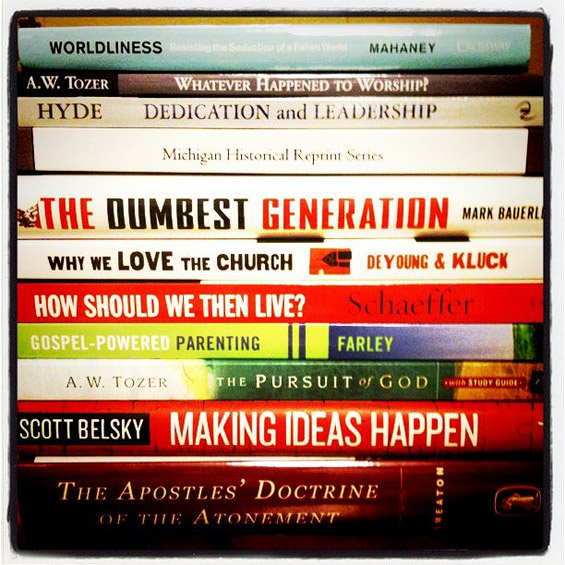
    Literally every book I got for Christmas (2010). 2011 is shaping up to be the year of “input” (and if you don’t get that reference, go watch Short Circuit). I haven’t decided whether or not I’m going to try and read all of them this year. That would basically be one book a month and a few them are in the 500 page range. If I can resolve to read twenty minutes a day, I think I could it — the real question is do I want to? The verdict is still out on that. Either way you can expect reviews on everything I read.

    All the books listed from the top of the stack to the bottom (in the above photo):

    1. Worldliness by C.J. Mahaney
    2. Whatever Happened to Worship by A.W. Tozer
    3. Dedication and Leadership by Douglas Hyde
    4. Letters From a Father to His Sons in College by Samuel Miller
    5. The Dumbest Generation by Mark Bauerlein
    6. Why We Love The Church by Kevin Deyoung and Ted Kluck
    7. How Should We Then Live? by Francis Schaeffer
    8. Gospel-Powered Parenting by William P. Farley
    9. The Pursuit of God by A.W. Tozer
    10. Making Ideas Happen by Scott Belsky
    11. The Apostles’ Doctrine of the Atonement by George Smeaton
    *12. Style and the Man by Alan Flusser

    *not pictured

  • November15th

    No Comments

    I forget sometimes things I’ve come across or read that I want to share with people, but today I remembered a fantastic resource that you need to be aware of. The Southern Baptist Theological Seminary (SBTS) has a great, updated website with some wonderful resources for Christians. Specifically they have put together digital booklets for free download which I highly recommend. Though I haven’t read them all, I have read the “From Boy To Man: The Marks of Manhood” and thought it was a very helpful resource on the topic of Biblical manhood. Obviously I have a vested interest in the topic as a man myself and with a son that is quickly growing, but I’m sure the other topics (counseling, modesty, homosexuality, and pastoral ministry) would be of interest to you.

    You can download all of the booklets for free by visiting “Southern Resources” or by clicking the specific links below (all links are direct to the PDFs):

    From Boy to Man: The Marks of Manhood
    Counseling and the Authority of Christ
    Homosexuality and the Bible
    Modeling Modesty
    The Pastor as Theologian

  • July29th

    1 Comment

    Though many have already read this 25 year old book, I just recently finished Neil Postman’s “Amusing Ourselves to Death “. I need to write a full review of this book sometime, but for now I’m going to leave you with this cartoon a friend forwarded me this week. I can’t stop talking about this book — it has opened my eyes to a lot of different culture influences. This cartoon does a great job of summarizing some of Neil’s larger points as he compared the philosophies of Aldous Huxley and George Orwell.

    (via Recombinant Records - cartoons by Stuart McMillen)

  • July2nd

    2 Comments

    Photo © Shay Thomason

    Ever since she went “missing” in the Indian ocean, I can’t help but keep up with the story about Abby Sunderland — the 16 year old girl trying to circumnavigate the world in her sail boat. If you’ve followed the story (or heard the news), you know she was basically a little over half way in her voyage when her boat was crippled by rough water and winds. Thankfully, she was equipped with location devices which she manually set off when her mast was destroyed and she laid in wait for rescue. The nearest boat to her was over 400 miles away, but Australian search teams did a fly-by and were able to contact her via radio to confirm she was OK. After about 40 hours of bobbing in the middle the ocean, a French fishing boat was able to rescue her while leaving her crippled boat behind to presumably sink. But however amazing and incredible the story already is, I think it’s just the beginning.

    The tide has turned (so to speak) in this saga, and it’s headed straight for Abby’s parents. People everywhere want to know one thing: why would they let a 16-year old girl sail around the world alone? A few years ago they let their son Zac Sunderland attempt the exact same feat which he completed in mid-2009. Zac was 17 years old when he finished and it took him 13 months to make it around the globe. Abby, a year younger and maybe not as experienced as Zac, has now abandoned her quest and it was a dangerous voyage. But I have yet to find an article regarding Zac’s successful trip and blaming his parents for letting him complete the task. Were their parents doing the right thing then by letting him go and now they are to blame for Abby’s failed attempt? — I think not. The problem is not the Sunderland family’s parenting model, it’s everyone else’s.

    We’ve long forgotten the days when “adolescence” didn’t exist — that is, this weird time our culture has created between childhood and adulthood. It’s a scary place where teenagers have little to no responsibility and learn to remain in childhood until they are at least 18 and then they’re allowed to venture out on their own. Newt Gingrich wrote a very interesting article in 2008 titled “Let’s End Adolescence” in which he basically gives proof for the failure of this “social experience” we call adolescence. As well he gives examples of young people who accomplished great things with their lives. He writes,

    Benjamin Franklin was an example of this kind of young adulthood. At age 13, Franklin finished school in Boston, was apprenticed to his brother, a printer and publisher, and moved immediately into adulthood.

    John Quincy Adams attended Leiden University in Holland at 13 and at 14 was employed as secretary and interpreter by the American Ambassador to Russia. At 16 he was secretary to the U.S. delegation during the negotiations with Britain that ended the Revolution.

    Daniel Boone got his first rifle at 12, was an expert hunter at 13, and at 15 made a yearlong trek through the wilderness to begin his career as America’s most famous explorer. The list goes on and on.

    [via Bloomberg BusinessWeek, originally pubslished Oct. 30, 2008]

    That’s why the problem is everyone else. The culture we have created in America doesn’t want young people to go out and do hard things anymore. They’re either “too young”, “too inexperienced”, or any number of excuses we have created for them and there are no longer any expectations on them. The Sunderland family believes that young people have more to offer and they live by that. They understand that young people weren’t designed to sit around and play video games. They’re not here to just be a drain on our economy as the media teaches them to consume, consume, consume. Just because Abby didn’t make it around the globe in her boat doesn’t mean she failed. It means she tried to raise the bar for young people and call them to do something greater with their lives, and just because she didn’t finish doesn’t mean her effort wasn’t worth it. It’s also a call to parents to really look at the bigger picture here and realize that their kids are ready and able to do more than our weak culture thinks they can do. They are ready to be challenged with more than we are offering. They just need a little help from us.

    For further reading:
    Abby’s blog
    “Abby Sunderland Makes it Home” - The Rebelution
    Do Hard Things: A Teenage Rebellion Against Low Expectations by Alex and Brett Harris